
Ultimate Estate Planning Guide: Key Steps You Shouldn’t Miss

An estate plan includes all decisions regarding money, property, medical care, dependent care, and other issues that may arise when a person dies. This makes estate planning at the top of your to-do list to secure your financial future and ensure that your wishes are honored even after you pass away. If you are planning to start over or reevaluate your current plan, a well-organized estate planning checklist can make a big difference. Before you begin any planning, you may want to find an attorney who is knowledgeable about estate and tax issues.
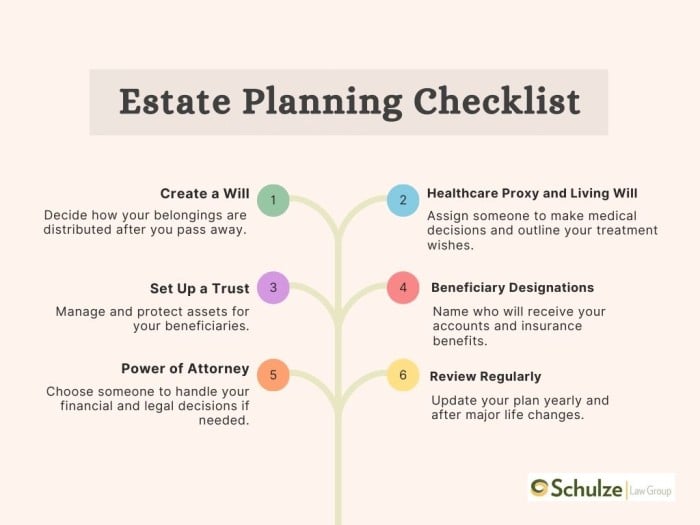
Here’s an essential planning checklist:
-
Create a Will
A will, often known as a “last will,” is a formal legal document that specifies how you want your possessions to be distributed after your death to your executor.
When someone passes away without a will, state law will control what happens to their estate.
The process of allocating your wealth after death is known as probate. Having a will guarantees your executor carries out your intentions; otherwise, your estate will go through the probate procedure. Without a will, the probate process is more costly and time-consuming, requiring the money to be taken out of your estate first.
-
Setting up a Trust
A trust is a formal agreement that permits one individual (the “trustee”) to hold assets on behalf of another individual (the “grantor”). Usually, this is done so the property’s beneficiaries can utilize it in the future. Any valuable object, including cash and real estate, can be placed in a trust with the help of your estate planning attorney in Reno.
When beneficiaries are young children who are not yet able to manage their entire inheritance, trusts can also be used to hold property. Then, until the beneficiaries reach a specific age, the property will remain in the trust.
Trusts are frequently favored because they circumvent the drawn-out probate court process and allow for speedier property distribution.
-
Power of Attorney
It is a choice whether or not to grant power of attorney to someone who can make necessary financial and legal decisions for you if you are no longer able to do so. Indeed, this is a mandatory part of your estate planning documents checklist, intended to prevent the unexpected occurrence of such situations and their subsequent complications.
-
Healthcare Proxy and Living Will
If a medical expert determines that you are incapable of making choices for yourself, you can choose someone to act on your behalf by creating a durable power of attorney (POA) for medical treatment.
-
Beneficiary Designations
Several of your belongings may go to your heirs without being specified in your will. For this reason, it’s critical to keep both a primary and a backup beneficiary on such an account. Because insurance plans may potentially pass away without a will, they should also include a beneficiary and a contingent beneficiary.
A court may have to decide what happens to your money if you don’t choose a beneficiary, or if the beneficiary is living abroad or incapable of fulfilling their obligations. Furthermore, a judge who is ignorant of your circumstances, convictions, or goals may reach the same conclusion as you.
-
Review Your Plan and Update your Documents Regularly
You are still not done! Since an estate plan is only as good as the person who formed it, you should regularly review all of your documents to ensure that everything is still accurate and in line with your preferences.
Examine them once a year and consider any noteworthy life events that might have an impact on your estate strategies, such as Births, deaths unions, and dissolutions. So, that there are no estate planning mistakes.
You should take action to make sure your estate plan is up to date if any of the situations mentioned above affect a designated beneficiary, a selected representative, or an appointed guardian.
Conclusion
Estate planning involves more than just determining how to divide up your possessions after death. It also involves ensuring that, in the event of your temporary or permanent incapacity, your beneficiaries, including your family, are taken care of and able to access your assets. Because of this, it is important for you to have the help of a professional on your side to make the right decisions for yourself and your loved ones.